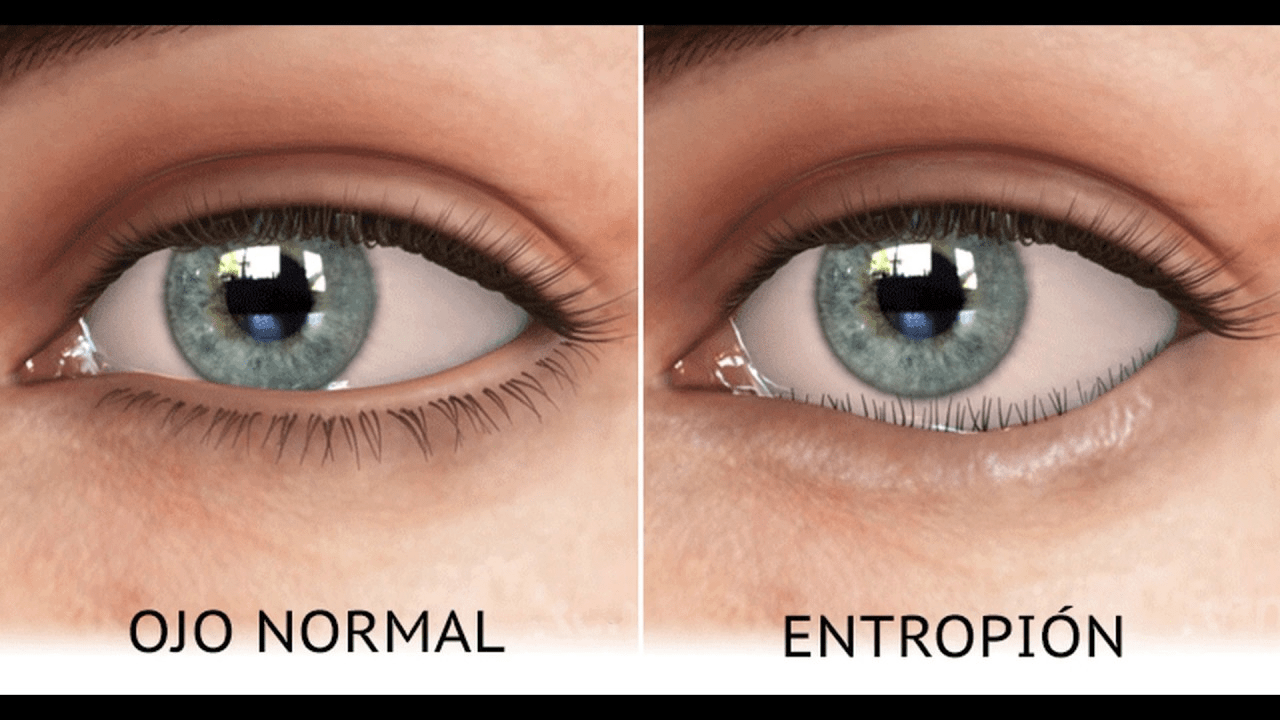
Humans are blessed to have eyes that enable them to see the beauty of the world. While most often the one aspect humans always take care of is the eye vision, other parts of the eye such as the eyelids often are missed. Not everyone has a normal eye which includes normal eyelids. If you ask a doctor, you will be surprised to know that some people have abnormal eyelids that may actually cause disturbance to the normal eye vision. Thus, what is the difference between entropion and normal eye?
To know the differences, we have to know what is considered a normal eye first. Normal eye is often referred to as the eyeball and its supporting part such as auxiliary structures. The eyeball itself consists of lens, pupil, iris, cornea and retina. Each of these plays an important role in enabling humans to see. Eyeballs are symmetrical in size and position. The upper lids cover the upper portion of the cornea when people are looking in a straight direction and eyelashes span outwards.
Entropion occurs where the eyelid turns inwards or inverted and causes the eyelashes to rub against the cornea. Cornea is the clear part of the eye located at the front of the eye. This will irritate the eye and cause pain. Entropion is more common in older people and generally affects the lower eyelid. It is worth noting that entropion may affect the upper eyelid but is considered rare. Entropion should not be confused with ectropion. Ectropion is the opposite of entropion which means the lower eyelids droop away from the eye and turn outwards. There are different types of entropion:
- Involutional or senile- Most frequent types and is associated with the degenerative alterations of muscles that stabilise the eyelid (refractor muscles). This produces an inversion of the lower eyelid.
- Congenital- A rare disorder that commonly leads to secondary glaucoma (disease that damages the eye’s optic nerve) in mid-teenage years.
- Cicatricial- Typically originates from a conjunctival scar in the inner eyelid.
- Spastic- Often caused by blepharospasm (uncontrolled eyelid movements).
Entropion is most cases are associated with tissue ageing. However, some cases are caused by different conditions such as formation scar from a trauma such as burn or inflammation. Entropion in young age can be caused by genetic or birth problems. It is best for patient suspected with entropion to get checked by doctor. This will help patient to get the right treatment.
Symptoms often be presented as eye redness and pain, sensitivity to light and wind and watery eyes (epiphora). Patients often describe a foreign body sensation as if there are other objects in the eyes. Since most cases of entropion are in the elderly, sagging around the eye can be seen. Patients might complain of vision problems if the entropion starts to damage the cornea. Dry eye syndrome is present in more than half of patients with entropion. Dry eye syndrome often is presented as irritated, scratchy, gritty and burning eyes. It is important to treat entropion as entropion that persists can cause eye infections such as ulcers and even corneal scarring that is difficult to treat.
Treatment often revolves around surgery. Surgery is done to stabilise the eyelids and to ensure it does not turn inwards. Even though surgery is said to be the best way to fix entropion, some patients might be wondering if there are alternatives. This includes using tape to prevent eyelashes from rubbing against the eyes, carbon dioxide laser skin resurfacing and Botox injection to the muscles affecting entropion. It is worth noting that alternatives are often offered as temporary measures until patients can have surgery or when patients are too sick to undergo surgery. Artificial tears and ointments are used to protect the surface of the eye and improve symptoms.
In essence, the difference between the normal eye and ectropion is the eyelids that turn inward in entropion. Entropion is more than just the symptoms that cause discomfort and eye vision problems. When left untreated, it can cause serious eye issues that may cause permanent blindness due to the serious corneal damage. Surgery is the mainstay for treating entropion. Alternative or conservative treatment may help patients to alleviate symptoms but it can never cure entropion as much as surgery does. While in most cases surgery will solve the entropion, in rare cases, entropion may not fully go away.
It is important for patients that constantly rub their eyes or notice the eyelashes turning inwards to the eyes, to get examined by doctors. Those already diagnosed with entropion should see their doctor if their symptoms such as pain, decreased vision or redness become increased or more severe. Entropion is diagnosed by routine eye examination. Specific tests known as snapback tests and distraction tests are often used by doctors to check for entropion. Slit lamp may be used for assessing the eyelid.
 Women 4 Health